What is an airbrake?
Whether you’re a seasoned tech or just starting out in the world of sniping, one of the most common questions I get asked is “How do I make my rifle quieter?”
One of the most effective tools for sound reduction is tucked away at the very end of the piston. I’m talking, of course, about the airbrake.
In this post, we’re going to look at what they are and how they work.
What is an Airbrake?
Simply put, an airbrake is a physical extension attached to the front of your piston head. Unlike a standard flat piston heads that relies entirely on a rubber damper to absorb impact (if they even have that), an airbrake-equipped piston has a extension that reaches out toward the cylinder head and enters the nozzle.
If you’ve seen the W.A.S.P. kit, you’ll know I’m a big fan of including these. They aren’t just a “one-size-fits-all” part, they come in different lengths and thicknesses because every rifle setup (cylinder volume, barrel length, and spring strength) reacts differently to how air is restricted and it’s generally a balancing act to get the best out of them.
How Does an Airbrake Work?
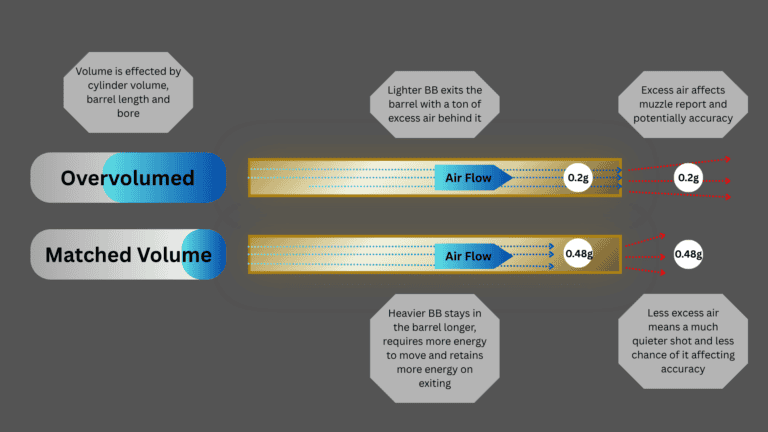
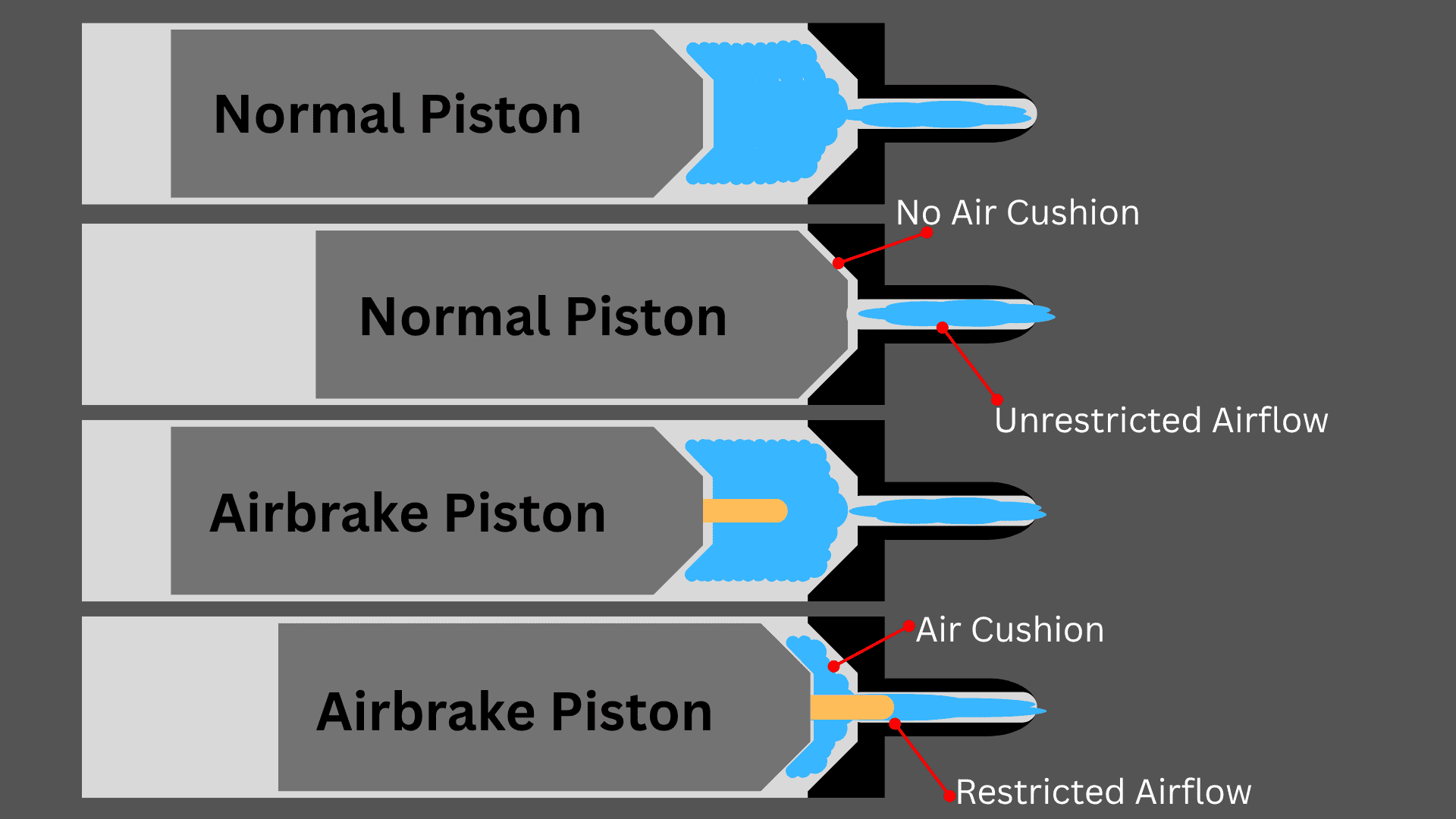
To understand how it works, you have to visualize the airflow inside your cylinder during a shot. Luckily, I’ve prepared another glorious piece of art to show case this.
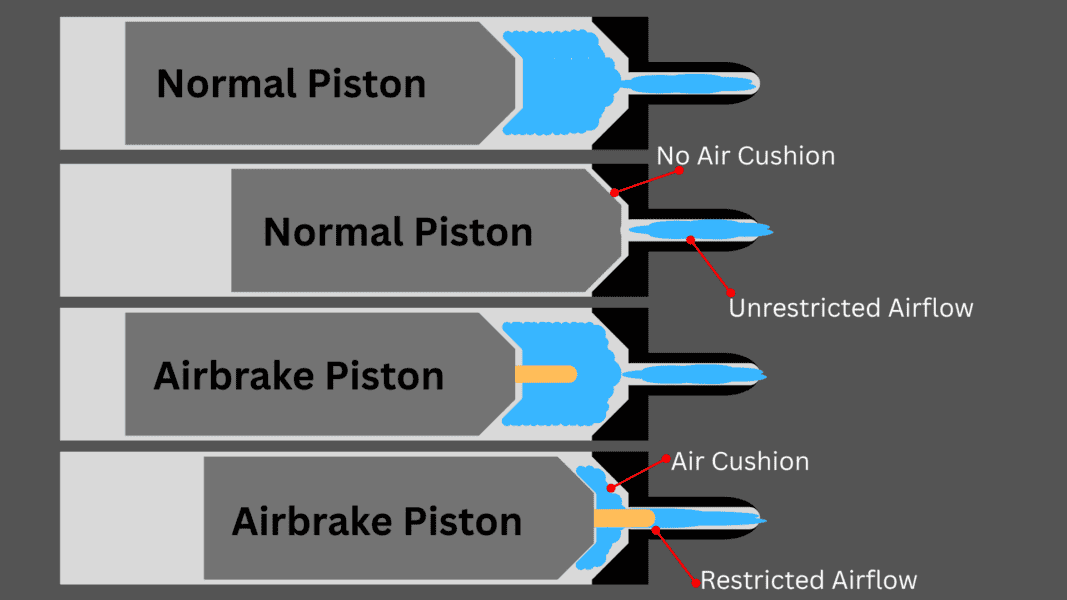
When you pull the trigger, the piston slams forward. In a normal setup, the piston accelerates until it hits the cylinder head with a loud mechanical thwack.
When you add an airbrake, the process changes:
- The Entry: As the piston nears the end of its travel, the airbrake enters the nozzle opening of the cylinder head before the piston fully hits the cylinder head.
- The Air Pocket: Once the airbrake enters that hole, it restricts the exit path for the remaining air. This creates a high-pressure pocket of air trapped between the piston head and the cylinder head.
- The Cushion: This trapped air acts as a pneumatic cushion. Instead of a hard mechanical impact, the piston is forced to slow down rapidly as it tries to push against that trapped air.
The result? That sharp “clack” is replaced by a much duller “thud,” making your rifle significantly harder to track from a distance.
The Trade-Off: Power vs. Silence
It’s important to remember that airbrakes aren’t “free” upgrades. Because you are physically slowing down the piston and restricting airflow at the very last second, you will almost always see a drop in FPS/Joules.
This is why tuning is so vital. If your airbrake is too long, it will “choke” the air too early, and your consistency will tank. If it’s too short, it won’t provide enough of a cushion to actually quiet the rifle.
In my own testing, I’ve found that the “sweet spot” is finding the shortest brake that still gives you that signature muffled sound without sacrificing too much energy. If you’re building a dedicated “silent” build, the airbrake is easily one of the most powerful tools in your arsenal—as long as you’re prepared to tech it properly and understand the trade offs.
One final note, due to the fact the air brake relies on pressure, it’s also heavily relies on a having a good air seal. If you have a leak someone where, the pressure will be to low and the piston (especially if it’s a weighted piston), will carry enough force to push through the air and force it out wherever the leak is.