Joule Creep Explained: Efficiency vs Creeping in Airsoft
Introduction
Hey guys, welcome back to the blog. Today we are diving into a topic that seems to confuse a lot of players, techs, and site owners alike: Joule Creep.
If you’ve spent any time looking at high-end sniper builds, HPA systems, or GBB setups, you’ve probably heard the term thrown around. But what exactly is it? More importantly, what is the difference between a gun being Joule Efficient and a gun that is actively Joule Creeping?
Let’s break down the mechanics, the math, and what it means in simpler terms.
What is Joule Creep?
In simple terms, Joule Creep is a phenomenon where the muzzle energy of your airsoft gun (measured in Joules) increases when you switch from a lighter BB to a heavier BB.
Historically (in the UK at least), airsoft sites measured a gun’s power using Feet Per Second (FPS) on a standard 0.20g BB. The logic was simple: if your rifle shot 500 FPS on a 0.20g BB, it was outputting roughly 2.3 Joules of energy.
However, airsoft physics doesn’t quite work like that and to be fair, things have changed over the years with how we check stuff now.
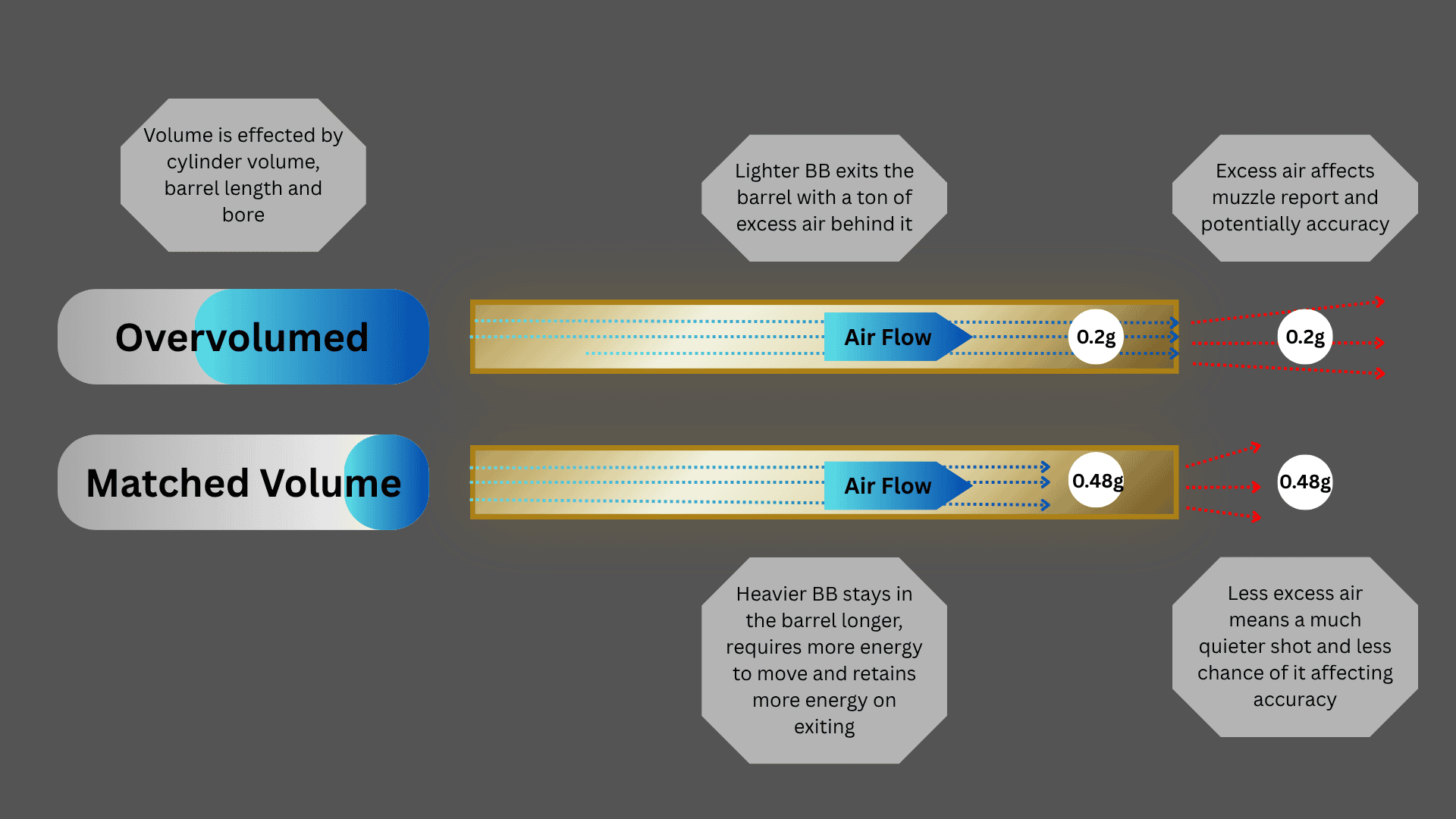
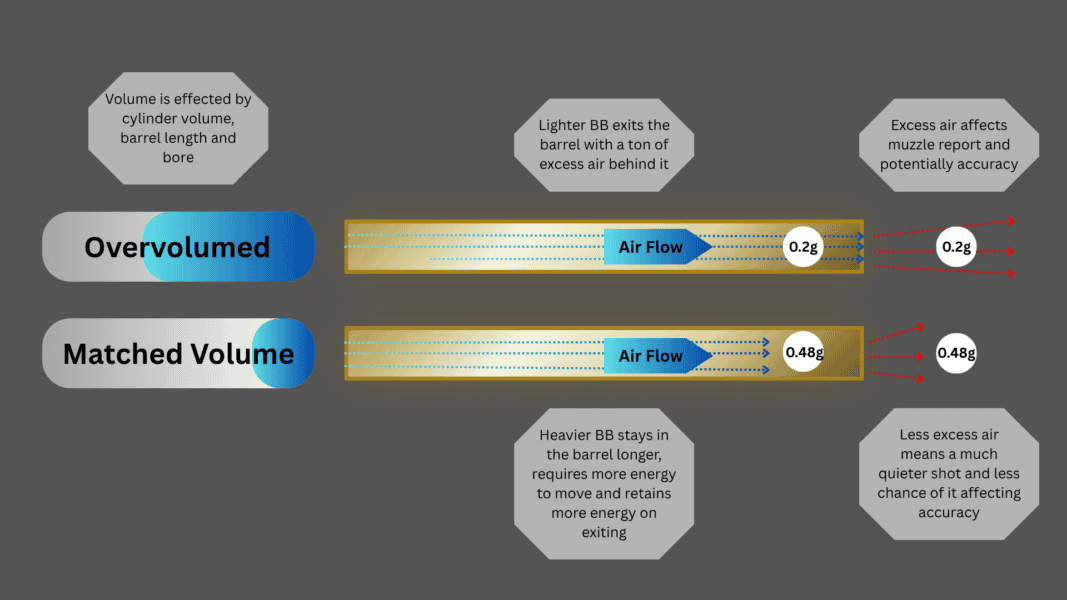
When you fire a light 0.20g BB, it accelerates very quickly and leaves the barrel before the air in your cylinder or HPA line has fully expanded. That leftover air is wasted—it just blows out the end of the muzzle after the BB is already gone. This is also why you have that muzzle crack, due to all the air thats left.
But what happens when you drop in a heavy 0.45g or 0.48g heavy BB?
- The heavier BB has more inertia, so it starts moving more slowly.
- Because it accelerates slowly, it spends more time traveling down the inner barrel.
- This extra time (dwell time) allows the compressed air to expand fully behind the BB, transferring more energy to it and with the BB itself having more weight it absorbs and retains it more effectively than light BB’s.
The result? The BB exits the barrel with more kinetic energy (Joules) than the 0.20g BB did. That’s Joule Creep.
Joule Efficient vs Joule Creeping: What’s the Difference?
This is where things get interesting for us techs. A lot of people use the terms Joule Efficiency and Joule Creep interchangeably, but they are actually two very different things when it comes to balancing your build.
Let’s look at the breakdown.
1. Joule Efficiency (The Sweet Spot)
When a build is Joule Efficient, it means the volume of air inside your cylinder is perfectly matched to the volume of your inner barrel and the weight of the BB you are using.
In an efficient build, you aren’t trying to trick the chronograph. Instead, you are ensuring that your rifle converts as much of its mechanical energy as possible into pushing the BB.
- The Goal: A flat energy output across your intended BB weights.
- If your rifle outputs 2.3 Joules on a 0.30g BB, and still outputs roughly 2.3 Joules on a 0.45g BB, it is perfectly balanced for air volume (though this rarely happens, there is more often than no a marginal creep or it can go the other way if undervolumed).
This gives you incredible consistency, a quieter shot profile (no excess air popping at the muzzle) and potentially better accuracy due to no additional “tubulence” behind the BB as it exits
2. Joule Creeping (The Over-Volumed Build)
Joule Creeping happens when a rifle has a massive excess of air volume relative to the barrel length. This is incredibly common in short-barreled HPA systems and bolt-action snipers with heavy pistons and large cylinder volumes (like the Silverback SRS or TAC-41).
In a creeping setup:
- A 0.20g test BB might read 1.8 Joules on the chrono.
- A 0.45g heavy BB pushes the reading up to 2.5 Joules or more.
While some players deliberately build rifles to take advantage of this to shoot “hotter” on the field, it poses a major safety risk. It’s the reason why the UK and many international fields have switched to Chronographing in Joules using game-weight BBs rather than FPS with 0.20g ammo.
Why This Matters for Your Build
If you are building a dedicated sniper rifle or DMR, understanding this balance is crucial for both performance and legality.
To achieve high Joule Efficiency, you need to balance your piston weight, spring power, and barrel length. For example, using a heavier piston (such as adding a weighted sleeve) slows down the initial movement but maintains momentum, is able to push through the air pocket resistance that the narrow nozzle generates, which pushes heavy BBs down the barrel with extreme consistency and efficiency.
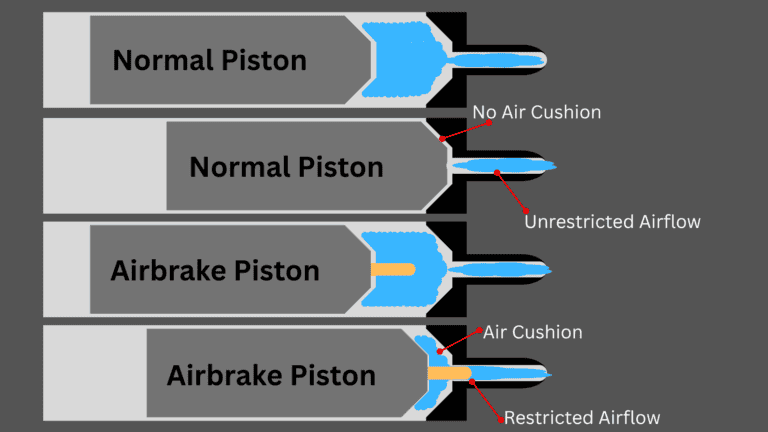
Another note to add to this is also the “air cushion”, this is basically the pocket of air at the end of thew pistons travel where nearly all air has been used but there is a bit left, which is under very high pressure (usually) due to the piston nearing the end of it’s travel and the air being forced though the small nozzle opening.
If the setup is under volumed or light ammo is used, then this pocket wont be there and the piston impact will be noticeably louder, especially if you’re using a heavy piston.
An airbrake makes us of this pocket by obstructing the nozzle and causing the air cushion to be under even more pressure and drastically cushions the last part of the piston travel and dampening the impact as the piston slows down as it’s hits and has to push that high pressure past the air brake and through the already small nozzle bore.
On a related and final note, an interesting way to measure joules would actually be measuring the joules at the 30m range impact point (as it’s a common MED for higher power rifles) and see what energy a 0.2g is left with vs a 0.48g. As the BB is technically accelerating still at the point it passes through the chrono at the muzzle…..food for thought.
Key Takeaways for Teching:
- Match your volumes: If you have a short barrel, you don’t need a massive, un-ported cylinder. Match your cylinder-to-barrel ratio (usually around 2.5:1 to 3:1 for heavy BB builds).
- Chrono correctly: Always test your guns with the exact BB weight you plan to use on game day so you don’t get caught out.
- Efficient is effective: Accuracy, consistency and sound all benefit from this.